
Globalizing January 6
What Trump is doing to world politics
_(retouched).jpg)
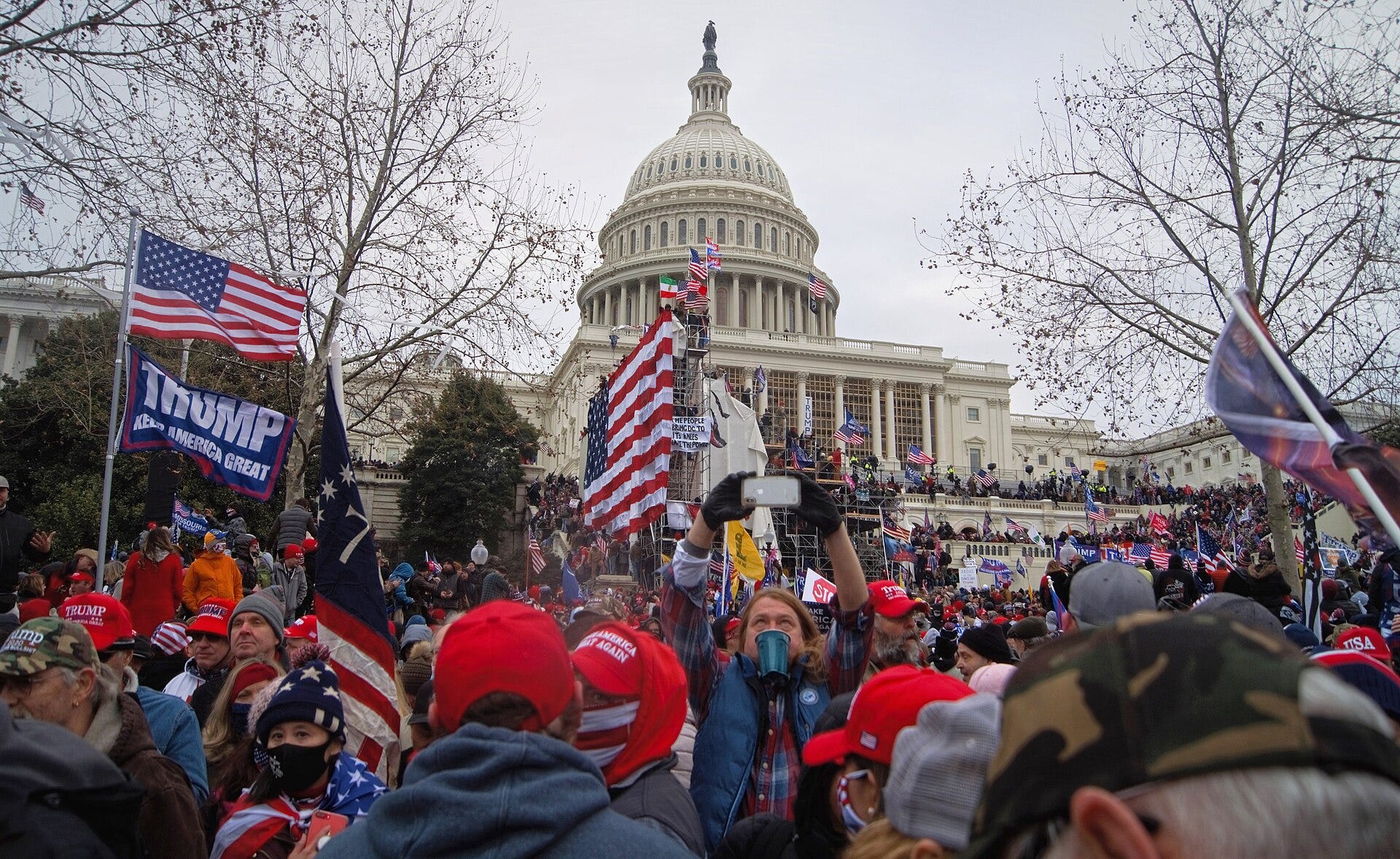
How should we understand the second Trump term’s effect on world politics? I contend we should view it as a global extension of the January 6 riots. It is a rupture of settled constitutional processes via made-for-streaming moments, a coming together of substantive change and online content via a performative rejection of normative and settled practices. Call it a coup, an autogolpe, a revolution from above—it is a sustained assault that is shocking to the senses and the expectations. It also has about it the quality of epater les bourgeois—shocking the established—and of pour encourager les autres—demonstrating the power and violence inherent in the new system.
Much as January 6 melded grasstops and grassroots activism (some drove RVs to the affair, others flew by private jet), and much as J6 rested on a feverish and cultivated mix of innuendos, disinformation, and crude lust for power, the first year of the second Trump administration (or, to be accurate, the first fifty weeks—it hasn’t even been a year) has seen a systematic dismantling of alleged safeguards and assaults on international decency. It differs from J6 in that now power centers are largely wired to respond to the White House’s directions rather than to put up resistance.
A storied tradition in international relations scholarship viewed the international order established by the United States as akin to a constitutional order.1 The metaphor is helpful, although not in the way John Ikenberry once intended it. Trump is forcing a constitutional crisis in the Western international order. By removing the self-imposed restraints on U.S. power that secured other great powers’ participation in the system, the Trump administration is unsettling expectations about future behavior—ruling through fear, not love. No more self-binding; now, self-aggrandizement.2
From global public health to Greenland, from Venezuela to Kyiv, the administration acts to profane the symbols and values of the liberal order. The analogy to J6 is even more precise. If American views of proper democratic procedure and substance constitute a civic religion of the United States, the Capitol, and especially its Rotunda, are places empty of politics but full of meaning, like the Holy of Holies. Governance does not, really, take place there, but the symbols of governance do—and they were sacked, vandalized, desecrated. Although international order cannot be said to reside physically anywhere, the practices and customs of the American imperium make up their analogue—and they are being gleefully, sophomorically, energetically shredded by every X meme and Truth Social retruth, every casual jibe at other countries, and, of course, every use of force not for a specific goal but to show that it can be done. The high priest is burning the temple.
Trump and his cadres believe that right, as the world goes, is only in question between equals in power. For others, there is force. And so U.S. forces in Greenland and Europe, once a shield of allies or protectorates, have become a sword dangling over the Western heartland.
The dangers of January 6 were manifold but among them was the simple fact that shredding a constitutional order is dangerous for all involved. Many on the Trumpist side believed, sincerely, that right was on their side, and that justified extreme action—many may not have, but few act from a belief that they are the villains, rather than shaping their reality so that they are the heroes. What one intends is not what one receives. Once an order is shredded, the foundations for stability have been wrecked. Those who sow the wind will reap the whirlwind.
It is possible, I think plausible, that Trump and his coterie believe what they are doing is putting America first—and if they line their pockets along the way, well, that’s just honest graft.3 Thus far, little of the response to their actions has dissuaded them from this view—trade keeps going, planes keep flying, the gold pours into Mar-a-Lago. Every beam in the order they kick over totters with a tremendous crash, but the building remains standing. Someone carts away the rubble to sell for pennies. Each clamor spurs them to knock over the next one to the cheers of their backers. What’s the risk in smashing one more support?
The Green Dawn Scenario

I don’t believe it is likely Donald Trump will order the seizure of Greenland by military force, but I can no longer assert that I find it unthinkable.
Ikenberry, G. John. “Constitutional politics in international relations.” European Journal of International Relations 4.2 (1998): 147-177.
Ikenberry, G. John. "After victory: Institutions, strategic restraint, and the rebuilding of order after major wars." (2019): 1-336.
Riordon, W. L. (1995). Plunkitt of Tammany Hall: A series of very plain talks on very practical politics. Penguin.
January 6 was not merely a breakdown of democratic procedure but a moment of sacrilege, the public revelation of sovereignty through profanation. In that breach, America’s civic theology was unmade: what had resembled Excalibur, a symbol of rule-bound protection, gave way to the Sword of Damocles. Power ceased to reassure and began to expose. The exception displaced the norm. Across both hemispheres, partners now find themselves not within an order but suspended beneath discretionary will, contingent on impulse, performance, and intimidation.
I guess I disagree with the suggestion that we should extrapolate from January 6 to find the underlying theme of this administration. The common thread from that riot to today seems to me entirely Trump and Trump's character, which I have found consistent for the last thirty-five years or so. (The metaphor of the schoolyard bully and his socially disturbed sidekicks works simply and consistently over a great deal of his ever-widening inner-circle.) I don't think Trump was aiming on January 6 to make any statement about American political order other than that his will to power counted more.
The throughline is the failure of rest of the political order to respond. The first-term cabinet failed to invoke the 25th Amendment; the Senate failed to convict; the Biden DOJ failed to prosecute Trump in a timely manner; the Supreme Court failed (and fails) to understand the non-statutory "original intent" to foreclose monarchial concentration of power. (And so forth . . . ) Most of all, perhaps, a huge proportion of ordinarily ethical citizens seem unable simply to see Trump for who he is, something I never can get over.
The view I ascribe to Trump and his current inner circle -- their understanding of the "unitary executive" theory -- is a blending of a general political reduction of domestic and international orders to the exercise of totalitarian power and a semi-religious exaltation of Donald J. Trump and his personal characteristics to cult idol status because it will get them where they want to go fastest.
The parallels with the Weimar interlude seem to me increasingly clear, and the disaster-in-waiting is that there will be no last-resort USA to limit and reverse the damage. The world model that we're headed towards seem remarkably close in structure to Orwell's 1948, which was based on the goals of the Nazi and Japanese fascist version of three spheres of absolute influence. All that was needed for that to prevail was if, say, Lindbergh rather than FDR had been in the White House. (Or, more realistically, an un-dead Huey Long, proclaiming a Longroe Doctrine in acquiescing to Axis and Japanese Imperial visions.)