
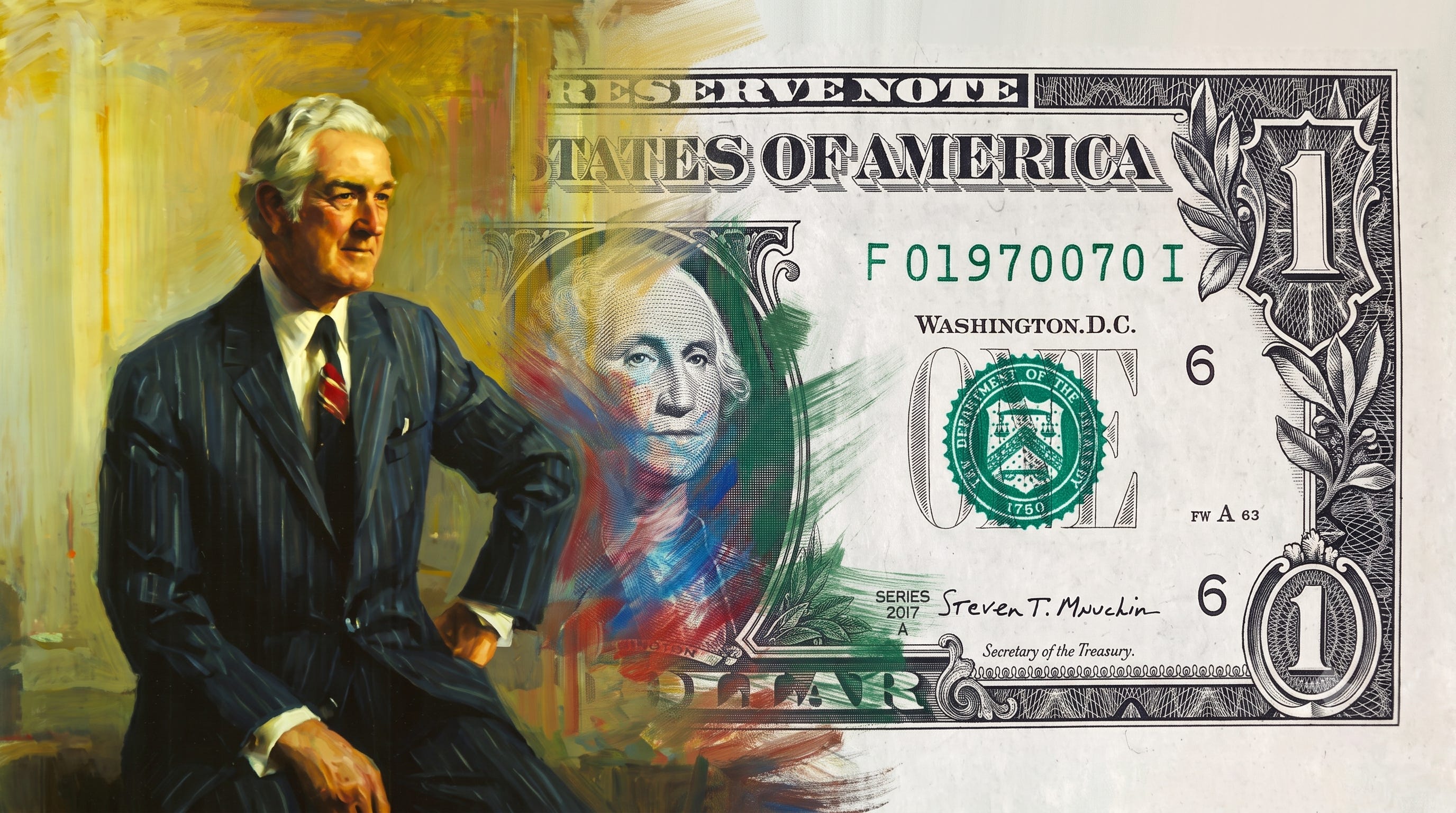
John Connally, a towering figure of American politics in the 1960s and 1970s, is these days remembered for two things. First, he was riding alongside President Kennedy when the latter was killed in Dallas in November 1963; an assassin’s bullet also severely wounded Connally, then the governor of Texas. As a result, Connally lived, becoming an iconic figure, a part of the breakup of the Solid South (the Democratic hegemony over white politics in the former Confederacy), and a figure in JFK assassination conspiracy theories.
Second, Connally became President Nixon’s Treasury Secretary, likely on account of his excellent hair and Nixon’s belief in his presidential prospects—Nixon saw in the former governor the future of a conservative party and a much more attractive political heir than, say, Spiro Agnew. For anyone involved in international finance, this latter service—coinciding as it did with the end of the gold standard and an earlier American shock to the system—has been Connallly’s more lasting legacy.
I’ll be teaching U.S. foreign policy and U.S. politics to undergrads here in Doha this term, a combination that I’m enthused by and depressed by: never have they been more relevant and never in my lifetime have they been more dismal. (The political scientists’ curse: may your research be relevant.) I think a lot about how to teach these subjects in a post-American world, a problem compounded by the catastrophe that the Trump administration has visited on the people and countries of this region.
When I seek to explain why students should take these courses, I’m careful to avoid any hint of a suggestion that other countries should become more like the United States—the sort of secular proselytization that Americans have habitually committed for two centuries and which is, at a minimum, unpropitious in these circumstances. Why, then, should anyone bother to learn about the United States in detail?
One answer comes, in an indirect fashion, from Connally. In 1971, during a meeting of the Group of 10 leading financial powers, Connally reportedly uttered the shocking but immortal line: “The dollar is our currency, but it’s your problem.” Not, perhaps, what the finance ministers of other countries that had built their economies on the basis of U.S. credibility had wanted to hear, but an unmistakable declaration nonetheless.
I return often to thinking of this moment of Nixonian honesty. The Connally Doctrine is simple: U.S. tools are wielded in the service of U.S. interests. Indeed, they always were—even the Bretton Woods agreements themselves were not, or at least were not intended to be, an act of U.S. magnanimity but the use of U.S. resources to order the world for the benefit of the United States, as wisdom gave policymakers the means to see the interests of the United States.
That U.S. institutions respond to U.S. politics matters; that U.S. institutions have global import defines the extent of their importance. Taking seriously how a great power wields its power, and what leverage matters most under what condition, is important; for those outside the United States, continually re-assessing why Washington acts as it does requires understanding that the system the U.S. built is not natural but artificial, its supports not laws of nature but acts of politics. The Connally quotation reminds us of why the United States can act as it does. Impunity has a quality all its own.
To understand what levers the U.S. will pull under what conditions, then, requires us to constantly go beyond the advertising and the superficial to think about the deep roots of power and what constraints matter when and to whom. U.S. power is Washington’s resource—and, under this administration, the world’s problem.
If you let a deranged monster pull all the levers at once, and keep doing it, they stop working
I hope you're developing a co-taught course with an expert in Chinese politics.