
Nixon Won
On Resignation Day, take a moment to appreciate his long-term success
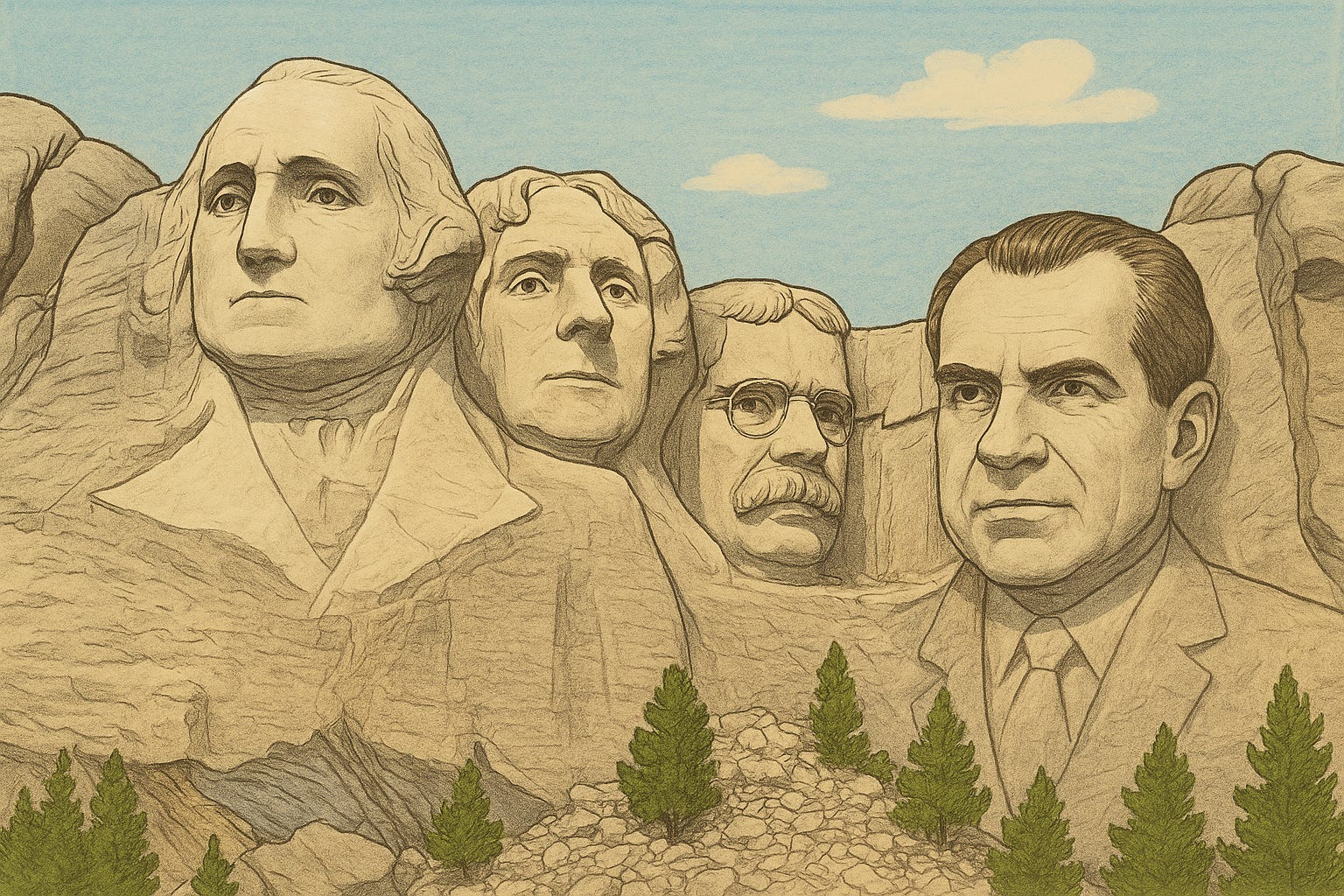
For a long time, I’ve tried to make August 9 into an American holiday: Resignation Day. Yes, Richard Nixon gave his resignation address to the nation on August 8, but it wasn’t until noon Eastern time on August 9 that he surrendered the powers of the presidency.
I had a dream. One day, we would sit on our lawns and sip Nixon’s favorite wine (Château Lafite Rothschild)—or at least a cheap California red that he would serve to White House guests while he was privately served the good stuff. We would lay out a slice of pineapple, some cottage cheese, and a glass of milk—Nixon’s favorite lunch!—like an empty seat at the Passover table. And we would listen to anti-regime songs, like "Ohio” and (funkier) Stevie Wonder’s “You Haven’t Done Nothin’” . All of this to commemorate a great political victory and to remind us that vigilance can work.
There have been two factors working against my campaign. First, not many people seem to care about Resignation Day—they should, as I detail below!—and, second, well, August 9 already has an infamous anniversary attached: the U.S. atomic bombing of Nagasaki.
Now, there’s a third reason. I’ll get to that next. As the clickbait formula says, reason #3 will depress you.
Why should Resignation Day be a civic holiday? Because it was the U.S. version of the Glorious Revolution—the deposition of an abusive ruler to affirm a political order. (And, happily, a political order much more fair and deserving of honor than that upheld by the English crown before or after some Dutch monarchs took title to it.) The saga of Watergate is about vastly more than a break-in (there were, for instance, multiple-break-ins): it was about an attempt to systematically debase and corrupt U.S. governmental institutions, from the statistical agencies to the security apparatus, in order to extend the rule of one leader.
Nixon’s crimes against the Constitution do not even begin with the break-in at the Democratic National Committee, and they continued long afterward. To summarize the summary of the Senate Watergate Committee report: Nixon’s coterie directed the use of official and para-official resources to harass the media; intimidate and sabotage other presidential campaigns; solicited campaign contributions—really, bribes—with the implicit promise of presidential favors; used those funds to further illegal activities; instituted reprisals against activists and critics; falsified government and other documents; destroyed records; suborned perjury and otherwise obstructed justice; turned the CIA and FBI into accessories; and used official resources to reward friends and allies. (And this list does not even include unrelated abuses, like that of the General Services Agency to upgrade the president’s private residences.)
Some of this had been done before. None of it had been done at this scale.
The immensity and length of the “Watergate” revelations led to the consolidation of what I, and I think just about zero other people, think of as the creation of the Nixon Constitution. That is, a set of popular understandings, Court rulings, and statutes that codified a set of expectations and formal limits on presidential power. In no specific order:
The expectation that the media would be an independent actor checking the power of the presidency, rather than (19th century) an arm of the parties or (20th century) either a court reporter or a tabloid
United States vs Nixon, which limited executive privilege substantially (and directly led to the resignation)
The War Powers Resolution, which was not about Watergate but was about restraining presidential power
The Federal Election Campaign Act Amendments of 1974, which imposed spending and contribution limits in an effort to clean up politics
Nixon vs General Services Administrator and the Presidential Recordings and Materials Preservation Act (and later the Presidential Records Act), which transformed the relationship between presidential records and the public (basically, the public suddenly had an interest in, and then ownership of, executive records)
The Government in the Sunshine Act, which sought to make the federal government more open and transparent, and other ethics reforms like the Office of Government Ethics
Amendments to the Freedom of Information Act to give the act teeth and make records actually available
A whole passel of reforms and changes to the Intelligence Community as the Watergate revelations led to other revelations and basically shredded the veil of secrecy around CIA and other agencies.
The Carter administration (“a government as good as its people”)
And in general the notion that the presidency was a fallible office and presidents could be pushed out of it by public and official demands.
These were very strong. They limited the ability of presidents to act constitutionally (court rulings), by law, and through honor and norms. Each of them responded to abuses that were, if not always exclusive to the Nixon administration, had certainly been taken to their extreme by Nixon.
And each of them has now been shredded.
That brings us to our third reason to refrain from celebrating Resignation Day.
Nixon won.
The presidency as Donald Trump wields it is far more unconstrained than that Nixon occupied. Indeed, given contemporary Supreme Court rulings regarding presidential immunity and bribery, many infamous abuses of the Nixon administration might not even qualify. (Hell, it’s possible that even Spiro Agnew’s graft—which included literally accepting cash in his office—wouldn’t qualify these days.) Many of the laws that sought to rein in the presidency have been eroded or vitiated—some gradually, some suddenly. And norms? There should be a plaque outside the West Wing: This place is not a place of honor.
Some of this erosion has taken decades to unfold. Some of it has unfolded quickly, within extremely recent memory. (Trump vs United States was 13 months ago!) All of it matters.
The presidency is now vastly closer to being an elected dictatorship than at any peacetime point in U.S. history. When I was young and read more (actual) reactionary thought, I recall that conservatives of the Human Events ilk were agog at the use of declarations of emergency to put through programs expanding presidential power. Trump uses emergency declarations like a punchline—an abuse of power that is gross in more ways than one.
Checks and balances? Obviously, the other co-ordinate branches of the federal government, and even most state governments, are not balancing in any meaningful degree. (Some political scientists are rushing to point at this or that third-order balancing, which is the literal definition of the forest/trees confusion.) The real checks, which were undertaken by institutions like the media, unions, and universities, have been eviscerated. (Nixon would have dreamed of using antitrust powers to break the CBS News division. What was once political science fiction is now political science fact.)
It’s hard, then, to celebrate Resignation Day. But that doesn’t mean we should forget it. Rather, we should observe it, as penance and as prayer. (The penance can involve actually eating the cottage cheese as ritual purification.) If America is united by a civic religion, we need a day of remembrance.
A great and timely piece. I think the big change is that Nixon felt a need to cover things up - even if he felt he was justified in his misdeeds because they met some self-serving definition of the greater good, he knew that there really were norms and expectations out there.
Our current president is remarkable in that the corruption is so open, so, in the end, *un*remarkable. He feels no need to explain his acts or statements - he has the power and that is that.
I've been thinking lately about the Access Hollywood tapes. At the time, the focus was on what dreadful things it said about how he treats women. But I don't think people realized it was much more than that, it was his entire worldview: if you have the money and power, there are no constraints, there are no moral considerations, there is no need to hide.