
Dual Collapse
The republic and the empire fall separately
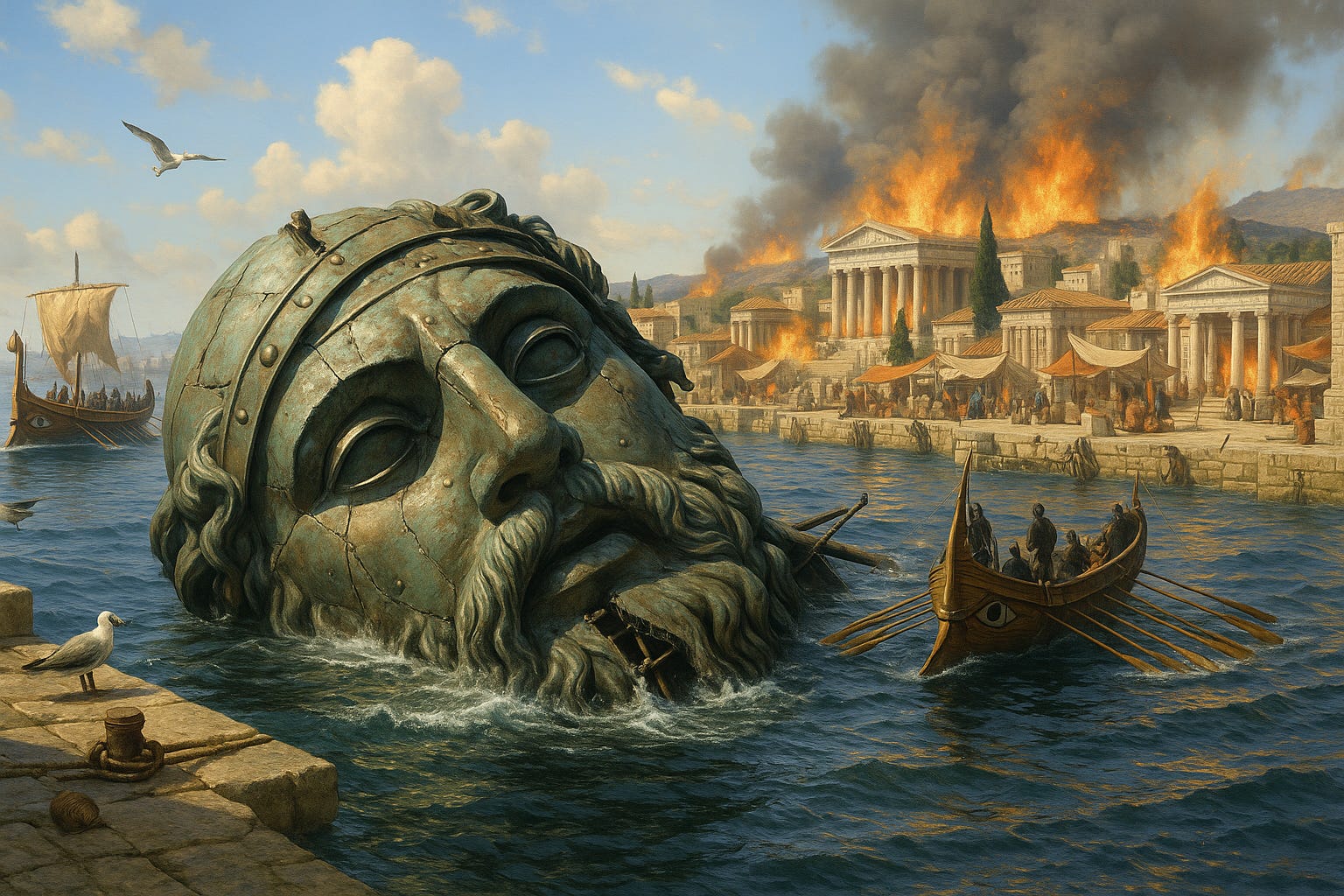
So much is changing in U.S. politics and international relations that our impressions about what is changing and how are getting jumbled. In this newsletter, I will argue there are two separate major developments happening simultaneously: authoritarian consolidation in the United States and the deterioration of U.S. reliability as a security partner.
I have been thinking about the relationship between U.S. politics and U.S. foreign policy for a while. In 2016, I drafted an article about how political polarization could lead to the dismantling of the U.S. hegemonic system. Because of the vagaries of peer review and academic publishing, it did not see print until 2019 (although it circulated before then). The basic thesis, however, has proven depressingly accurate.
Theories of international relations and of foreign policy that assumed that structural incentives, domestically or internationally, would bind the United States to a liberal hegemonic pathway were wrong. Instead, the role of political parties in mobilizing groups with disparate interests and identities was critical to understanding the range of policies that would be adopted. Since many of those identities were illiberal and anti-internationalist, and because the success or failure of political elites is due partly to random factors, eventually one or another of those “fringe” (as they were in 2016) elements would succeed in winning control of a political party and the presidency. If a party were relatively homogenous, then controlling the White House and both houses of Congress would make possible radical shifts in U.S. foreign policy.
In one line, I pointed out that both major tendencies in U.S. international relations theory had spent a long time barking up the wrong trees because they had been so focused on structure in place of political agency:
It should give pause to ardent defenders of the liberal world order that the most successful blow to American primacy came not from external balancing, as realists long predicted, but from the free choice of American voters.
Say what you will about Trump, he has been consistent — since the 1980s! — on wanting to pursue a violently illiberal path in foreign policy, and he made no secret that he was NATO-skeptical and Putin-curious. Most flavors of realist (and there are more of them than Baskin-Robbins ice creams) couldn’t perceive internal politics as a vector for such changes, and most flavors of liberal (mostly vanilla) couldn’t conceive of the public as anything but a far-sighted median voter.1 My argument concluded by pointing out that six months in 1898 had seen the United States rapidly turn from a century of comparative non-intervention into a global imperialist power, and that similar pivots were possible in the future.
Well, here we are in the land I prophesied. It sucks.
All hope is not lost; I’m not that pessimistic. But it is also time to be thinking about how this all went wrong — to understand the strange death of liberal American hegemony. And the first task is straightforward: we have to understand what is happening.
At the moment, and for good reason, many of my U.S.-based interlocutors are chronicling the demise of U.S. democratic institutions, symbolized by the demolition of the East Wing of the White House. (I think there are better ones out there, but nothing works as a symbol better than an event with dramatic visuals — or, in this case, the banal juxtaposition of ordinary demolition equipment dismantling part of a complex with extraordinary significance. It is, as much as anything, an act of desecration, a casual despoiling of the holy of holies of the American civic religion.)
Outside of the United States, the bigger development is that the Trump administration is walking away from the hegemonic—or imperial, if you prefer—systems developed since 1945. I say since 1945 because as part of the administration’s remarkably dogged persistence in dismantling everything FDR built, it appears that the United States will be bringing back pre-Good Neighbor Policy approaches to Latin America. The hemispheric focus of the administration recalls Theodore Roosevelt, while its reliance on force recalls Woodrow Wilson—not the St. Wilson of the League of Nations, but the bullying Wilson of the Pancho Villa raids and Caribbean occupations. (One might also say that the use of military force against drug dealers recalls the declining Qing empire, with the part of opium played by fentanyl.)
I want us to get this right. This is a dual collapse. Authoritarian consolidation and hegemonic withdrawal (or imperial collapse) are distinct. Although they are coincident, they are analytically independent.
Hegemonic withdrawal, or at least recalibration, is something a great many folks on the left and right have asked for for a long time. In varying and often contradictory forms, it’s sailed under many flags: isolationism, retrenchment, restraint, anti-imperialism. One variant is here, and the Trumpist version has been messy, deadly, and sudden. (I no longer have lectures on humanitarian aid in my U.S. foreign policy class; what’s the point?) In a proof that it’s always been easier to destroy than to create, the infrastructures and even the very relations that would be necessary to rebuild such agencies in the future have been wrecked. I think transactionalism is overhyped as a master key for US foreign policy, but no partner country will do business with the United States in the foreseeable future on any project that requires longer than a single administration. They knew exactly where to hit liberal internationalism: reputation, trust, and values.
What is amazing is that this form is not what would have been required by anti-democratic acts at home. Although the unpopularity of foreign aid, for instance, has been exaggerated, in the event few were ready to stand up for the lives of others. In other words, modulo some process points, what Trump has done could have been done under perfectly democratic processes.
Indeed, authoritarian consolidation might have been expected to preserve U.S. hegemony. Why not? Even if you think that Trump is a crude grifter, a global skimmer of ten percent off the top, the opportunities for doing so while preserving NATO, U.S. commitments to rich countries elsewhere, and so on would have been greater than what we have now. I know from social media that U.S. libs love to mouth that this or that Trump policy is weakening American foreign policy, but I think it may not be grasped how much U.S. legitimacy has been torched over the past few years—not by Trump alone, it must be said, but the past several months have definitely not helped. From Poland to the Gulf, allies and partners are wondering exactly what the meaning of costly alliances are if the U.S. is no longer willing to serve as even a night watchman hegemon.
The dismantling of U.S. hegemony, then, is something that is logically distinct from authoritarian consoidation domestically. The turn toward a naked grab for a great power division of the world — one in which the United States will pursue hemispheric exclusion and domination — represents a particularly bizarre caricature of the U.S. public’s potential acceptance of some form of retrenchment after the “forever wars”.
Grasping that Trumpism involves a simultaneous assault on both pillars of post-1945 liberalism — a large policy abroad to keep the world safe for democracy, and an expansive set of institutions designed to extend and make meaningful popular participation in governance at home — and that these are separate assaults — will help you keep the stakes clear—and to imagine ways back from it.
In particular, something I think that my earlier writing can help us with is the realization that we should be clear that there’s nothing “natural” or “inevitable” about the previous system. Franklin Roosevelt himself was not an inevitable president, and subsequent administrations faced choices in modifying and reaffirming parts of the general system laid down in the 1940s. To put it another way, there does not have to be a rallying cry to go back to the world as it is and the Constitution as it was. We can and must think about creative ways to address distinct problems.
If you want the nuanced version of this for scholarly purposes, you can read the article.