
A Lunch in Qatar
Analyzing an ordinary meal
A famous old Onion article reported on “Grad Student Deconstructs Take-Out Menu”. I use the verb “reported” because, although the periodical is satire, this article, like many layers of The Onion, is more truthful than most straight news reports:
Realizing he hadn’t eaten since lunch, the Ph.D candidate picked up the Burrito Bandito menu. Before he could decide on an order, he instinctively reduced the flyer to a set of shifting, mutable interpretations informed by the set of ideological biases—cultural, racial, economic, and political—that infect all ethnographic and commercial “histories.”
To non-academics, I suspect this article is funny, but not particularly so. To people experiencing academia, it’s funny in a disturbing way.
Timothy Burke once compared graduate school to heroin: this is your brain, this is your brain on graduate school. I don’t know what it’s like for STEMdinistas, but if you are in the humanities or the social sciences—that is, if your subject concerns life, the thing you have to live—his perspective is right. Theorizing and study becomes addictive and transformative; it both provides a permanent head’s-up display giving you context for what you are seeing and renders it impossible to gaze upon the world without the chatter of some long-dead scribbler. “You are never not an academic–the little mental tape recorder is on all the time, or it had better be if you want to be good at this life,” Burke writes, accurately.
Today, I made lunch in Qatar.
I am a scholar of international relations, and I specialize in U.S. foreign policy and international hierarchies. I live in Qatar, which is a part of the U.S. basing network and is now officially a U.S. ally, but whose foreign policy escapes easy categorization. (Strategic spectacles? Tactical networking? Mediation-as-a-Service?) Everyday life here is, as The Onion’s graduate student called it and as real academics really say, a rich text.
Here is the lunch, annotated:
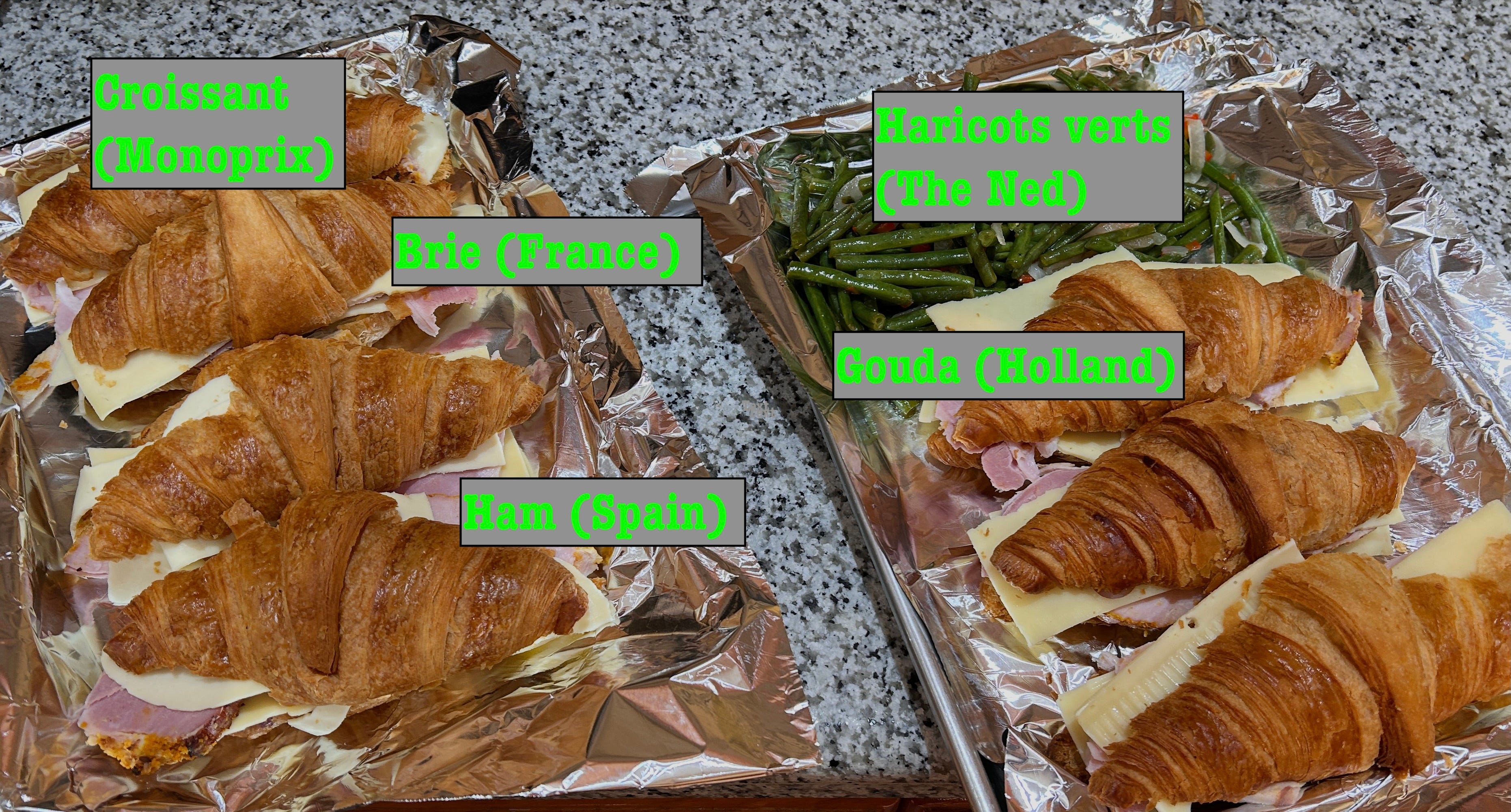
Thanksgiving notoriously provides leftovers for days; Christmas dinner is less celebrated but the helpings still endure. This year, Christmas Eve dinner was a ham bought at the Qatar Distribution Center. QDC is famous as the only place in Qatar where you can buy (off-license) alcohol; less famously, but more important for me, is its status as the only place where you can buy pork products. Getting admitted takes an application and a license, which are not hard to get but do require both a statement of income and a declaration of religion. Only non-Muslims, you see, are allowed to buy pork.
The population of Qatar is circa 3 million. QDC allows three freezers of pork products for the country’s expat population, 2.5 million of which are expats (and a good chunk of those from pork-consuming societies—Hoy mga Pilipino!).
(This is one of the more notable ways in which Qatar maintains a distinctively cultural attitude toward certain practices. In a resort in Oman, I once walked over to a large station with ham and cut off a good chunk; in Dubai, pork is—well, not everywhere but it’s a lot more available. To be clear, I’m not criticizing—countries should have different rules and practices!—but I think some of you find the at-the-coalface experiences I relate here to be interesting.)
The selection is seasonal(ish). A couple of months ago, half of a freezer was given over to Oktoberfest bratwursts and frankfurters (pretty good, 8.5/10). During the “jolly season”, there’s suddenly cooked hams and pork meatballs available. Rather like shoppers during the Soviet period, when you see a pork product you like, stock up even if you have no immediate plans for it—you never know if it will vanish next week or linger for months. On the other hand, there’s always bacon (the real, American kind—as well as the stuff the Brits claim).
Having alcohol sales restricted is not much of a hardship for me; it turns out that Covid briefly accelerated and then all but killed my desire for drink. Further, I’m coming around to the position that alcohol has comparatively few upsides (aside from the occasional pleasures).
But it turns out that I do, in fact, miss ham sandwiches, a lot.
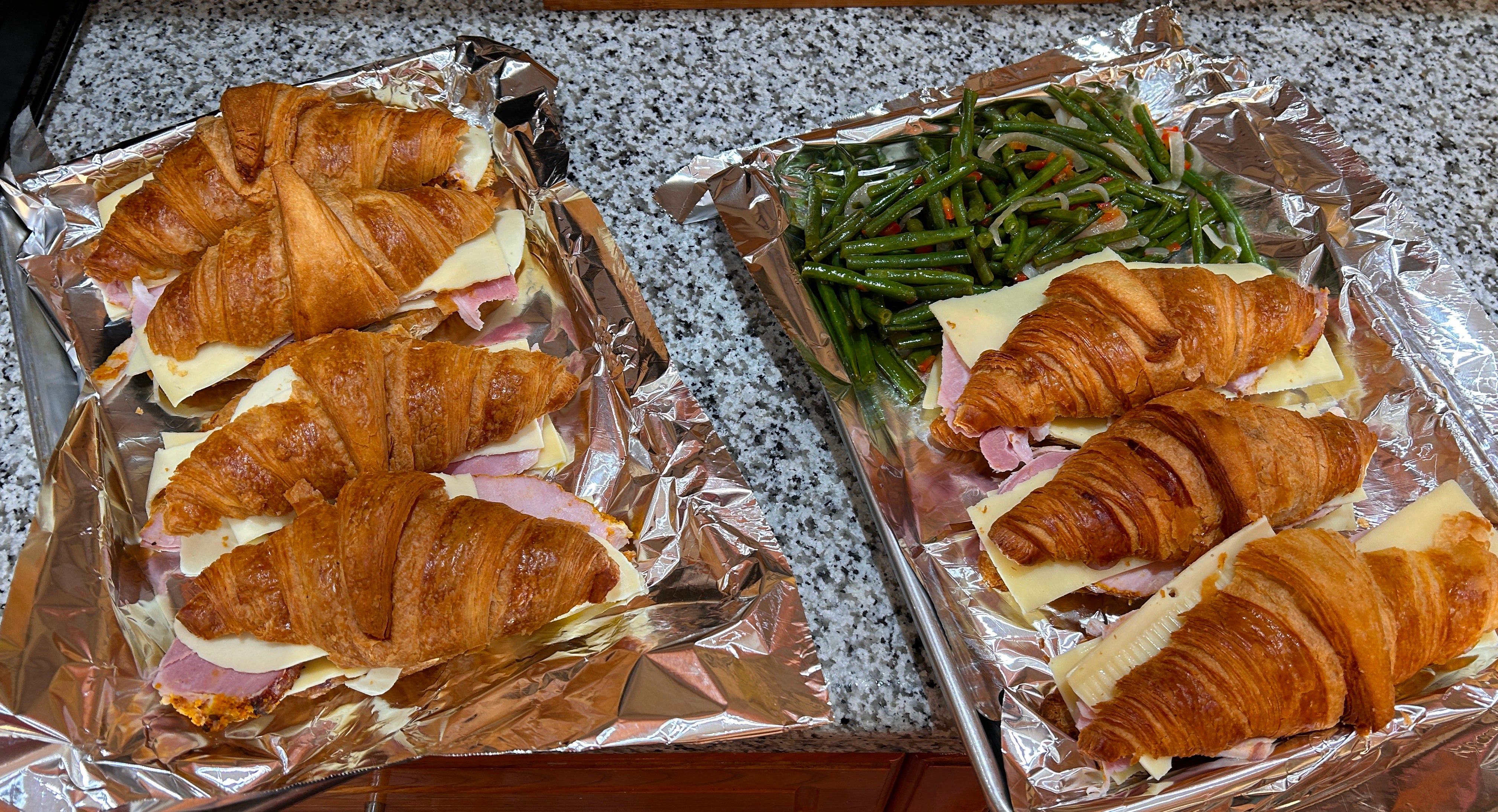
So it was that I confronted lunch today. There wasn’t much in the way of bread, but the refrigerator did have leftover ham. Cutting board, knife, thin slicing—first stage easy.
The second stage was begun even before the first. Among the cheeses in the refrigerator was a sliced brie—who even knew this was an option? Imagine typical U.S. sliced cheese but it’s brie. Well, brie + ham is the beginning of a recipe—and how else to make the ingredients into a meal but to get croissants?
There were no croissants on hand but that is never an obstacle in Doha. Doha has more serviceable croissant vendors than most places I have lived in, and even if few approach the quality of a Parisian cafe you can more than make do with the selection here if you’ve ever had to buy your croissants at a place called Schnucks. The even better part is that almost everything can be delivered through services like Talabat or Snoonu, which are like Amazon if Amazon were fast.
Plus, I happened to need Coffee-Mate (which, it turns out, is perhaps my biggest U.S. brand loyalty that I can actually source here), and croissants + Coffee-Mate = Monoprix, the French grocery store (not to be confused with Carrefour, the French grocery store that has croissants but not Coffee-Mate). The only downside is that Monoprix takes an hour to deliver, as opposed to the 20-40 minutes for most places. So tap tap tap on Talabat and then on to the rest of the prep.
The refrigerator also happened to hold some leftover green beans from Christmas Day dinner, which was outsourced to The Ned this year. (No, I am not a member—although if there’s an influencer discount, I’m listening!—but the club does also do a brisk business in holiday programming for non-members.) In general, the food was quite good, but I find that I like my haricot verts a little more cooked, so into the oven those would go too.
The croissants arrive. Pre-heat the oven—a lifetime of semi-cooking in Fahrenheit means that treating “200 degrees” as a cooking temperature rather than a warming temperature has taken some getting used to—and begin assembling the sandwiches. One slice of brie and one slice of gouda for each, with the ham between. The brie is soon exhausted, replaced by Emmental. (Did you know “Swiss cheese” is really American? There’s no such thing outside of North America; you have to use Emmental or Gruyere to come close to the taste profile of a classic ham-and-swiss sandwich.)
The theme of the lunch is quickly becoming “French”, so time to ensure the condiments reflect this:
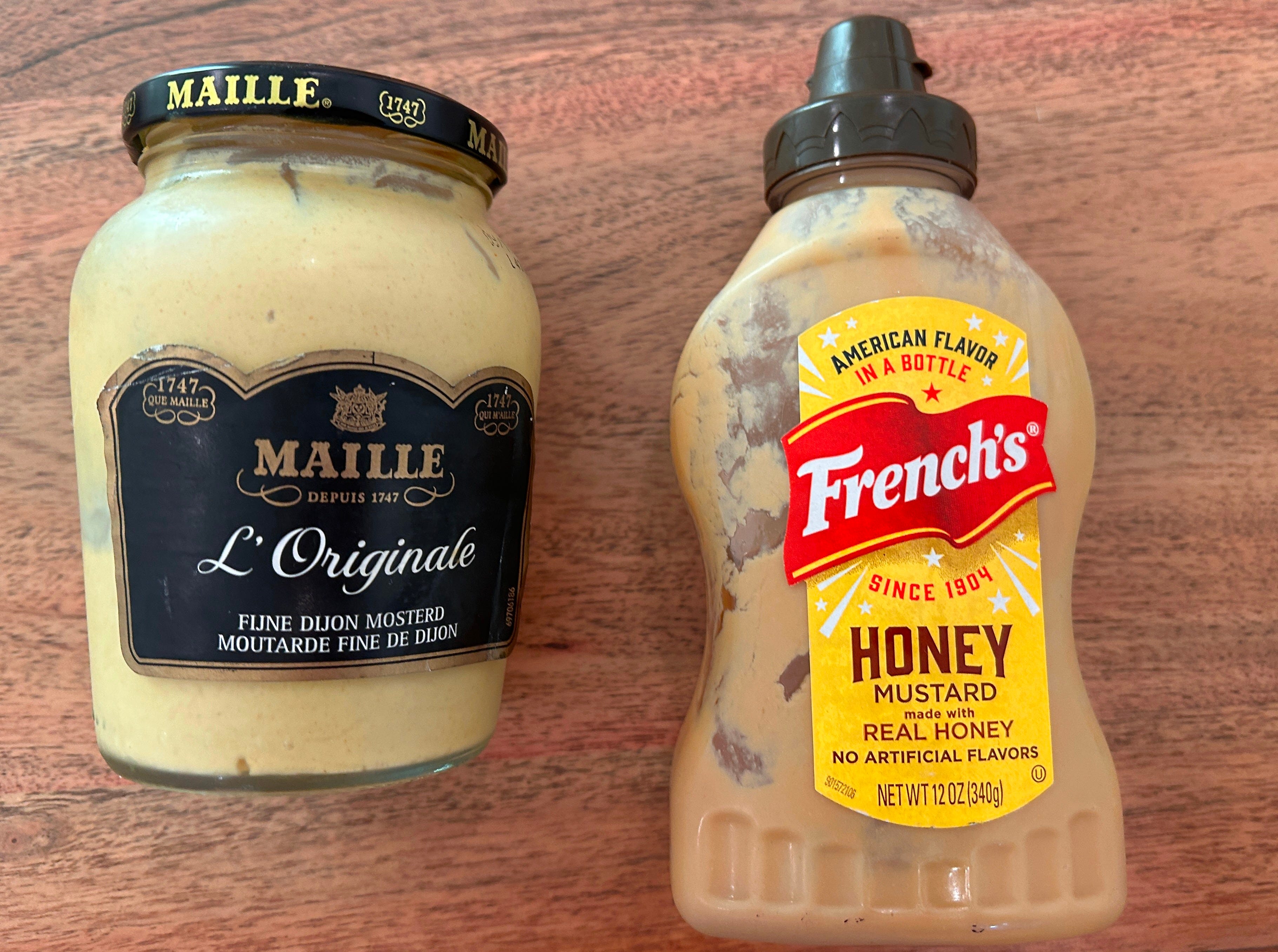
Mustard, of course, is French. And the honey mustard is French’s, too!
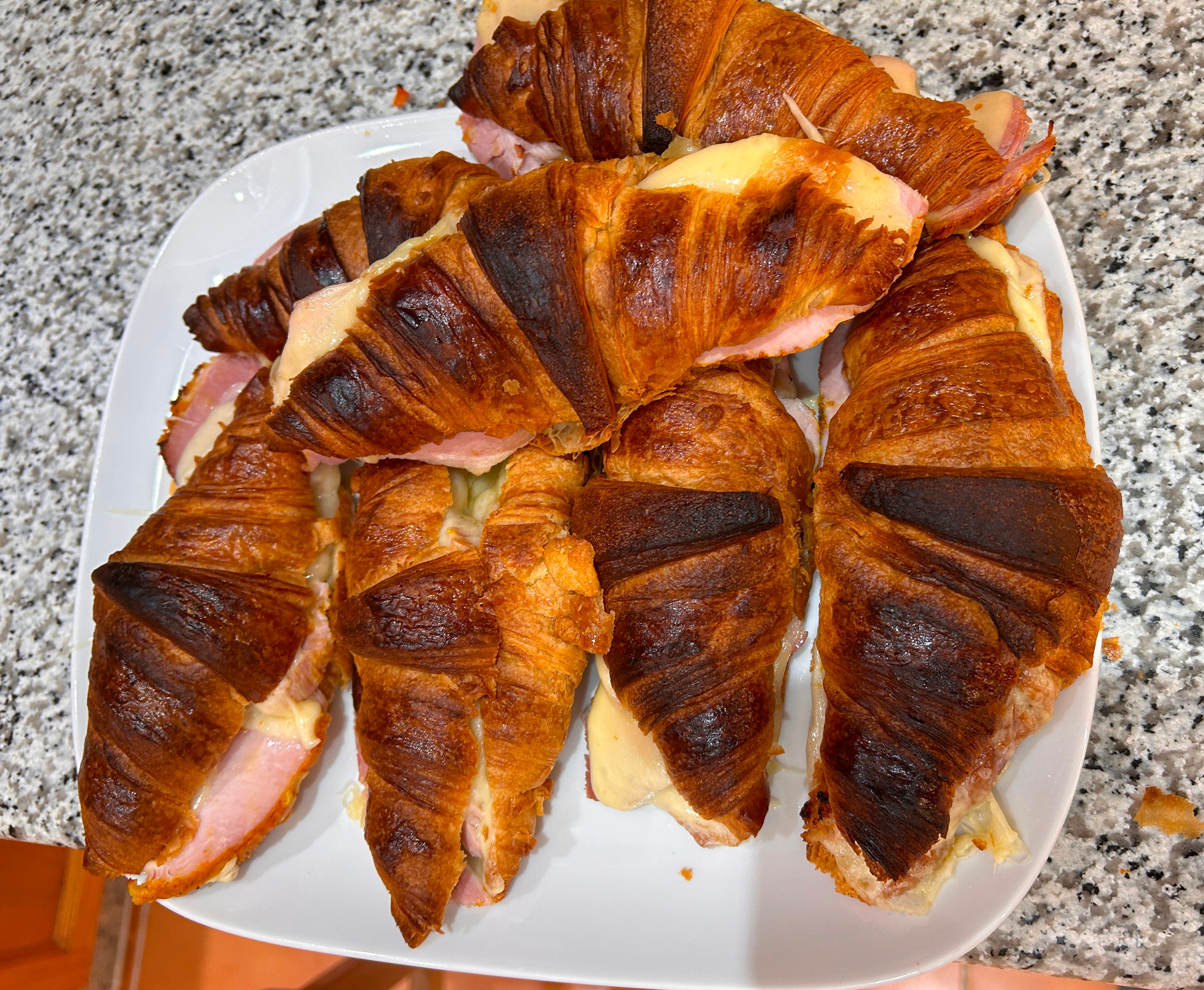
Service. Plates, forks, and napkins to the table. The croissants are warmed (perhaps they should have been ten or twenty degrees lower and a few more minutes, but the taste is fine and the look is only slightly below).
Sandwich, vegetable … what to round it out with? Potato chips! And what says “France” better than French cheese potato chips by the Lebanese brand Master?
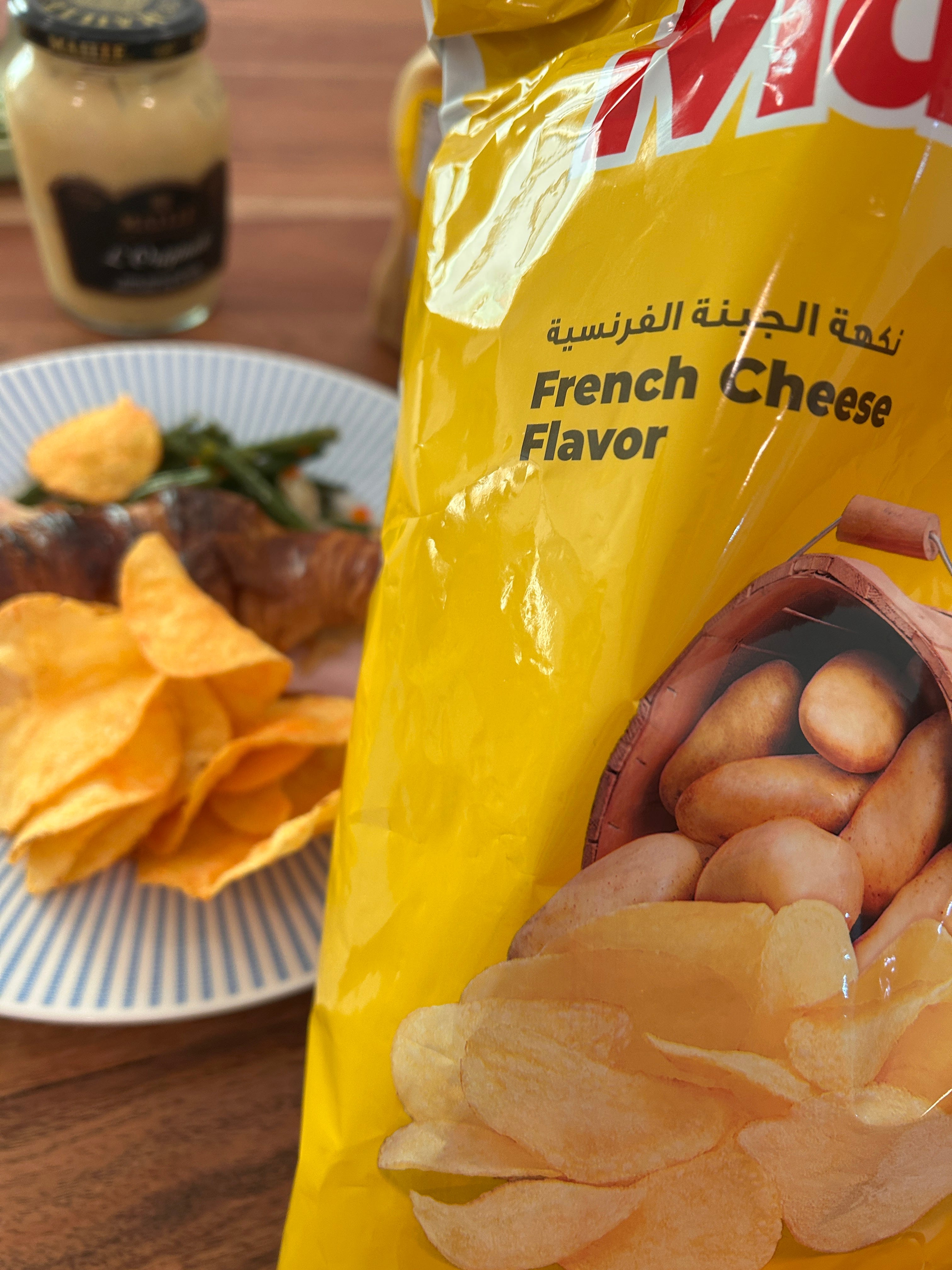
The final meal, served on a Kate Spade plate and in a surprisingly chip-forward plating:
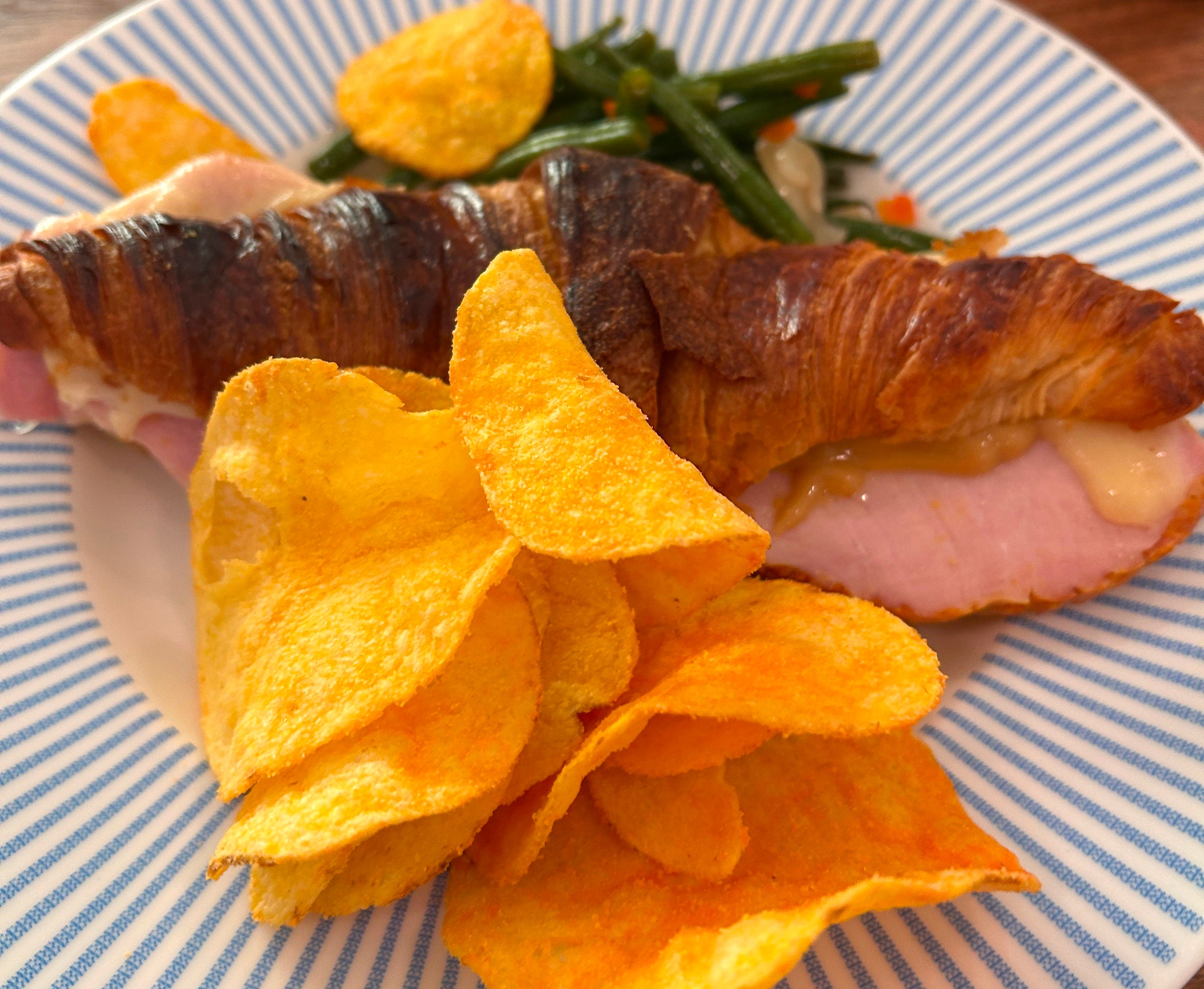
What are we to make of this plate as a text? One way it to consider the political economy of the lunch. Almost everything on the plate was imported (I’m going to guess that the Ned imported the green beans, although it is possible they were grown for Torba or one of the other farms here). Food security is a sensitive point in Qatar; the 2017 blockade of the country’s land borders brought to the fore just how much food it takes to feed a country of three million whose natural agricultural land was never called upon to feed more than a tiny fraction of that before the past several decades. You can (and I have) go to the port where practically all the seaborne trade of the country, including I suspect my chips and ham, came from; it is large but not excessively so (it doesn’t rank in the top 50 globally by volume traded), and the whole country depends on it. Food security, as a result, is a major goal of the state—before coming here, I would have read sentences like “reaching a self-sufficiency rate of 39 percent” in the “strategic vegetable sector” with a bit of a smirk, but being here means that this is no laughing matter. (And is it really possible that the country has 98 percent self-sufficiency in dairy? Well, the milk all does seem to have a flag of Qatar on it … )
The croissant, however, was not imported, although I bet the flower was. The more immediate lens to view this through would seem to be cultural and religious. Of all the texts on the plate, this might be the richest one; although it seems apocryphal, the shape of the croissant has been asserted to commemorate a Christian (probably Austrian) victory over a Muslim (probably Ottoman) source, a likely fictitious story that nevertheless has led to bans of the the pastry in more zealous times. (You can read a lengthier discussion of the status of the pastry under Islamic law here; I think that the strongest argument against prohibition is simply that the stories about the origin of the shape are unattested and likely wrong.) Yet in another sense the croissant is an import, as its production and consumption are wrapped up with the status of French culture (high) and the relationships between France and Qatar (fairly high, as reflected in energy deals, arms deals, and the fact that I bought this from a Franco-Qatari franchised grocery store).
And what of the entire idea of the meal? My theme was “French” but this emerged more or less as a joke; I never seriously thought I would duplicate something that a Frenchman would regard as anything less than ordure americaine. So did this American just replicate an American meal abroad?
The only answer is: Maybe? To be sure, I doubt any American circa 1950 would have recognize this as an American meal—croissants were exotic outside of the metropole well into the 80s and 90s. Nevertheless, I can’t help but think that this is as American as you can get—and yet only the mustard (yes, I used the honey mustard for mine) and the plate itself were, actually, American-made.
What makes the plate seem most American to me is the chips. But can I really assert that potato chips are, themselves, “American” in spirit? Chips (“crisps”) are English in origin, American in popularity, but now global in appeal—and I don’t buy the Master brand because of some sort of quota; it’s actually better than other imports. (The really Qatari thing would have been to use Omani chips—really, the brand name is “Chips Oman”—but I prefer to eat those in their natural habitat: as part of chapati.)
There are, then, at least four analytical approaches to understanding this lunch in Qatar for the international relations scholar:
as a question of identity and how cultural mores permit, forbid, encourage, or shame certain modes of consumption (why are croissants banned here but not there? why is pork allowed under these conditions here but freely there?)
as an instance of trade in goods, and how small states interact with the rest of the world and how globalization has reduced the distinctiveness of local markets
as an example of status, and how some cultures come to be regarded as sufficiently high-status that associating with them is desirable, even strategic
and, of course, as an example of migration, and how migrants bring more than just their labor to a society—I have brought my skills, habits, and demand with me to the point that even I can’t tell if the French sandwich I made is American or what.
Is this all deconstructing the takeout menu? I don’t think so, actually, although my reasoning here might be motivated. Dissecting what others do is my day job—why shouldn’t I dissect what I do on the weekends? And is it, in fact, really so silly to dissect the takeout menu? It might be silly to do it poorly, but thinking about how cuisines and cultures are repackaged for consumption abroad is surely worthy—when does my culture become your aesthetic?
Thinking about international relations means thinking about questions like these and how they are imbricated with not only the operation of power but also the movements of goods, ideas, investments, and people. If I’m selfish, which everyone attached to a discipline is, I think that these questions become more important because they’re attached to fundamental questions about how people do and how people want to relate themselves and their societies to other people and peoples.
That’s a research agenda that spans the abstract and terrifying—nuclear war—to the immediate and seemingly trivial—like making ham-and-cheese croissants in Doha. For many decades, scholars focused on questions. like the former and dismissed questions that touched on the latter. But is it really sensible to dismiss everything we actually do in international relations? Potential importance matters, but surely actual practices must count for something, too.
Chips in chapati? Is that like fries in falafel?
Oddly, I had a political theory revelation last night while speaking with my mother. At 92, she wants to be able to ride her bike again and somehow believes that riding a two-wheeler would be easier than riding a trike. She simply ignored the central problem of balance because she wanted to be her younger self. She also rejected the idea of a tricycle because a recent attempt left her frightened.
This approach to life - I want and therefore should have or I fear and therefore reject - cannot be countered by logic because it's entirely emotion-driven. It makes so much sense of the current political moment as well.
Hobbes was right.
Notes and bibliography?